
Distance calculations between ZIP codes depend on the quality of the underlying ZIP code data. When ZIP codes are inaccurate, outdated, or poorly geocoded, distance outputs become unreliable, affecting logistics planning, proximity analysis, emissions calculations, and customer-facing delivery operations.
Distance engines and routing tools depend on upstream ZIP code data quality, so errors in ZIP code datasets directly affect downstream calculations.
This comparison reviews ZIP code databases commonly used to support distance calculation use cases in the United States, with context on international scalability where relevant.
The focus remains on data coverage, coordinate accuracy, update frequency, licensing, and structural consistency. The goal is to clarify how different datasets support distance calculations, not to evaluate routing engines or navigation tools.
The providers included in this comparison are GeoPostcodes, Melissa, OpenStreetMap, UnitedStatesZipCodes.org, SimpleMaps.com, and GreatData.com.
Each provider is assessed using the same evaluation criteria to help data engineers, product managers, and operations teams understand how ZIP code data quality affects distance and proximity calculations.
Comparison table
| Provider | Coverage | Coordinates Accuracy | Licensing | Best For | Key Limitation |
|---|---|---|---|---|---|
| GeoPostcodes | International across 247 countries | Fully geocoded WGS 84 | Commercial, self-hosted | Reliable ZIP-to-ZIP distance calculations | Straight-line distance only |
| Melissa | Worldwide, but stronger in the U.S. | Routing-API-based distance outputs | Commercial, usage-based | ZIP-to-ZIP routing distance | Third-party API dependency |
| OpenStreetMap | International but inconsistent | Variable by region | Open license, attribution required | Exploratory or experimental analysis | Inconsistent ZIP data, straight-line distance only |
| UnitedStatesZipCodes.org | U.S. only | Standard coordinates | Commercial, internal use only | Simple U.S. distance calculations | Internal-use licensing, U.S.-only scope, straight-line distance only |
| SimpleMaps.com | U.S. only | Standard coordinates | Commercial | Lightweight U.S. use cases | U.S.-only scope, straight-line distance only |
| GreatData.com | North America | Variable by region | Commercial | North American analysis | Variable accuracy, limited scope, straight-line distance only |
How to calculate the distance between ZIP codes
Calculating the distance between ZIP codes starts with geographic coordinates. Each ZIP code must be associated with accurate latitude and longitude coordinates. Distance is then computed mathematically between those coordinates, most commonly using a straight-line (great-circle) formula.
Distance calculation tools and routing engines operate downstream. They consume ZIP code coordinates as inputs and apply formulas or routing logic on top of that data. When ZIP code coordinates are incorrect, outdated, or missing, distance results are inaccurate regardless of the tool used.
For this reason, distance calculation depends first on the quality of the ZIP code database. Fully geocoded, standardized, and consistently maintained ZIP code data provides the reliable geographic reference layer that distance calculation engines depend on.
The providers below differ primarily in how they supply ZIP code data versus distance or routing functionality.
Provider categories
Commercial providers
GeoPostcodes, Melissa, UnitedStatesZipCodes.org, SimpleMaps.com, GreatData.com
Mapping platforms
OpenStreetMap
Free & open-source providers
OpenStreetMap
Best solutions to calculate the distance between ZIP codes
GeoPostcodes
GeoPostcodes provides a self-hosted ZIP code database covering 247 countries, enriched with cities and administrative divisions. The dataset is curated from more than 1,500 authoritative sources and is continuously curated by dedicated data specialists.
All ZIP codes, regions, and cities include latitude and longitude coordinates in the WGS 84 coordinate system.
Compared to GeoPostcodes, routing or distance calculation engines operate downstream and rely on the accuracy of the input ZIP code coordinates. GeoPostcodes supplies reference ZIP code data and verified coordinates that support consistent straight-line distance calculations at scale.
The solution is delivered as a single source of truth with a unified global structure.
Compared to Melissa, GeoPostcodes does not provide a routing API or driving time estimates.
GeoPostcodes delivers self-hosted reference data with fixed pricing, full data ownership, and international coverage, whereas Melissa focuses on API-based distance and routing outputs with usage-based pricing.

Melissa
Melissa provides a cloud-based solution for calculating distances and estimated driving durations between ZIP codes using its Street Route API. The offering supports ZIP-to-ZIP distance and travel time estimates for operational and transactional workflows.
Compared to GeoPostcodes, Melissa delivers distance and routing results through an API rather than providing self-hosted ZIP code reference datasets.
The service returns calculated outputs without exposing the underlying reference data and is licensed on a usage-based pricing model, while GeoPostcodes offers self-hosted ZIP code data with authoritative coordinates under a fixed pricing model.
Compared to OpenStreetMap, Melissa delivers a packaged distance calculation service rather than raw geographic data. OpenStreetMap provides open datasets that require additional processing, while Melissa focuses on ready-to-use distance and routing outputs.
OpenStreetMap
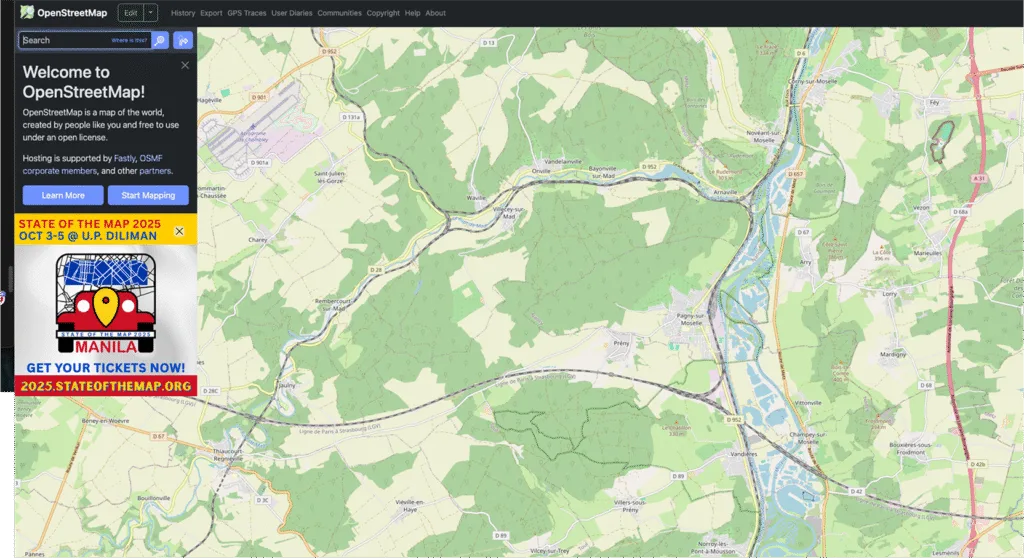
OpenStreetMap is a free, openly licensed geographic dataset maintained by a global contributor community. It provides granular geographic detail and is accessible through major cloud platforms such as AWS and Google Cloud.
The dataset includes roads, places, and geographic features across many regions. Commercial use requires attribution compliance, and support is limited to community forums.
Compared to GeoPostcodes, OpenStreetMap provides crowdsourced, raw geographic data rather than standardized ZIP code reference datasets.
ZIP code information can follow different tagging and normalization conventions by region, while GeoPostcodes delivers unified ZIP code data with consistent structures and curated coordinates.
Compared to UnitedStatesZipCodes.org, OpenStreetMap offers broader geographic coverage but does not provide standardized ZIP code data.
UnitedStatesZipCodes.org distributes a commercial ZIP code file limited to the United States, while OpenStreetMap ZIP code information typically requires user-side filtering, cleaning and normalization for ZIP-level distance calculation.
UnitedStatesZipCodes.org
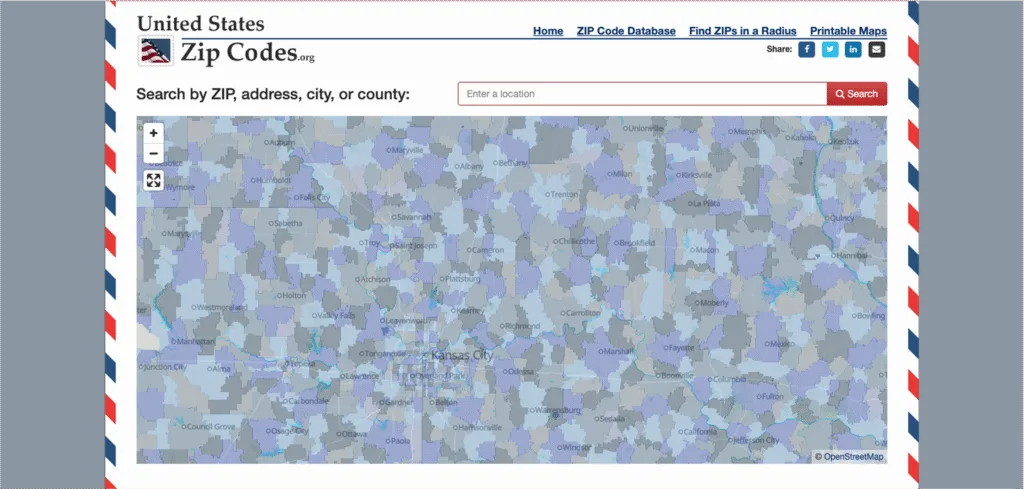
UnitedStatesZipCodes.org provides a low-cost commercial dataset covering 42,735 U.S. ZIP codes. The dataset includes latitude and longitude coordinates, Census statistics, population data, and city and county overlaps.
Files are delivered in a self-hosted format suitable for Excel or database imports. Licensing restrictions can limit reuse in analytics, redistribution, or customer-facing distance applications.
Compared to GeoPostcodes, UnitedStatesZipCodes.org focuses exclusively on the United States rather than offering a unified global reference database. GeoPostcodes provides a curated, standardized ZIP code solution with international scope, designed for enterprise-scale use cases.
Compared to SimpleMaps.com, UnitedStatesZipCodes.org offers similar U.S.-only coverage, with differences in update cadence and licensing terms. Both datasets are typically used for straight-line distance calculations based on ZIP code coordinates rather than routing logic.
SimpleMaps.com
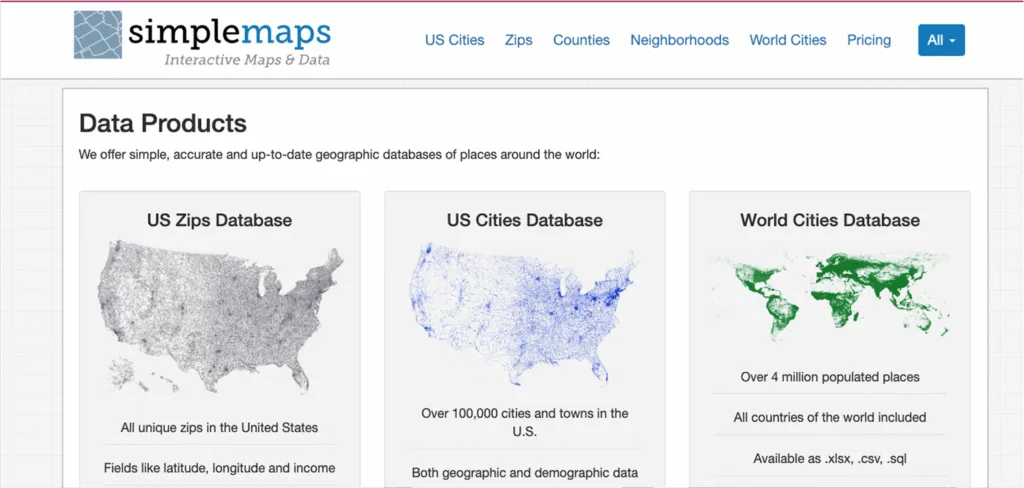
SimpleMaps.com delivers U.S. ZIP code and city datasets enriched with demographic attributes, time zones, and Census updates. The data is provided in CSV and Excel formats for integration into internal systems. The datasets are positioned for teams working with U.S.-only location data and cost-focused deployment requirements.
Compared to GeoPostcodes, SimpleMaps.com focuses on U.S.-only datasets rather an a unified global reference database. GeoPostcodes provides a unified global ZIP code structure designed for enterprise-scale use cases that require consistent location data to support distance calculations across the U.S. and international markets.
Compared to GreatData.com, SimpleMaps.com includes a broader range of enrichment attributes and publishes updates more frequently within the United States. Both providers supply ZIP code coordinates that are commonly used for straight-line distance calculations rather than routing logic.
GreatData.com
GreatData.com offers ZIP code datasets for the United States, Canada, and Mexico. The data includes latitude and longitude coordinates, demographic attributes, and USPS-based updates for U.S. ZIP codes. The data is delivered in CSV and Excel formats for self-hosted use and is positioned for cost-focused deployments working with North American ZIP code data.
Compared to GeoPostcodes, GreatData.com distributes regional ZIP code datasets with a limited geographic scope rather than a unified global reference database. GeoPostcodes provides a single, authoritative ZIP code database covering 247 countries, built for enterprise-scale distance calculation, reporting consistency, and robust data governance.
Compared to SimpleMaps.com, GreatData.com covers a broader North American region, but with a lower update frequency. Both datasets are used for straight-line distance calculations rather than routing.
What ZIP code database quality changes in real-world distance calculations solutions
In operational systems, ZIP code databases support distance calculations by providing latitude and longitude coordinates for each ZIP code.
These coordinates enable straight-line distance calculations between two ZIP codes, which are commonly used in logistics planning, proximity analysis, reporting, and CO₂ calculations.
The reliability of ZIP-to-ZIP distance calculations depends on the precision of the underlying coordinates and the consistency of the ZIP code definitions.
Datasets that rely on incorrect coordinates or incomplete ZIP code coverage can introduce inaccuracies, particularly in rural areas with large ZIP codes.
A standardized and frequently updated ZIP code solution reduces these risks by ensuring consistent geographic reference points.
Straight-line distance vs. routing distance
Straight-line distance, also called “as the crow flies” distance, measures the shortest path between two coordinate points. ZIP code database solutions support this method by supplying latitude and longitude values for each ZIP code.
This approach is commonly used for logistics planning, proximity analysis, tariff calculation and CO₂ calculations.
Routing distance, by contrast, depends on road networks, traffic rules, and routing engines. ZIP code database solutions do not calculate routing distances themselves.
Routing tools rely on ZIP code data as an input layer, which means inaccuracies in ZIP code coordinates can still affect routing outputs.
GeoPostcodes: ZIP code data that supports distance calculation
GeoPostcodes provides authoritative, frequently updated ZIP code data designed to support accurate distance calculation between ZIP codes at scale. The solution acts as upstream reference data, supplying verified ZIP code coordinates that downstream distance and routing systems depend on.
Its international coverage, standardized structure, and self-hosted delivery model support consistent distance calculations across regions without reliance on third-party APIs.