
Introduction
International teams depend on accurate, structured address data to support data engineering workflows, analytics pipelines, compliance processes, and logistics operations. Search results for “international address databases” mostly highlight address validation APIs rather than downloadable or self-hosted datasets. This creates confusion because APIs return validation results, but they do not provide the underlying address database required for ETL pipelines, batch processing, analytics, or global expansion.
This article clarifies the difference between address databases and address APIs, and evaluates the best international address databases available today. The focus is on dataset coverage, authoritative sourcing, standardization, update practices, and deployment models suited for enterprise-scale operations.
Comparison table: Best international address databases
| Provider | Database Availability | Coverage | Data Structure | Update Model | Licensing | Best For | Key Limitations |
|---|---|---|---|---|---|---|---|
| GeoPostcodes | Yes (downloadable, self-hosted) | 247 countries, guaranteed coverage | Standardized, authoritative | Curated updates | Fixed-cost | Global reference data, ETL, analytics, international operations, enterprise systems | Requires engineering to build the address validation layer |
| Google Maps API | API only | ~40 countries | Delivered through API responses | API-based | Volume-based | Consumer-facing forms | API delivery; underlying postal dataset not exposed for direct download |
| OpenStreetMap | Yes | Worldwide, community-maintained | Community-driven structure | Community updates | Open license | Map apps, research | Community-driven structure; teams typically standardize before integration |
| Smarty | API only | Worldwide | Delivered through API responses | API-based | Volume-based | High-volume validation workflows | API delivery; postal dataset not exposed for direct download |
| Melissa | API only | Worldwide | Delivered through API responses | API-based | Volume-based | CRM and MDM integrations | API delivery; postal dataset not exposed for direct download |
| Loqate | API only | Worldwide | Delivered through API responses | API-based | Volume-based | E-commerce and checkout flows | API delivery; postal dataset not exposed for direct download |
| PostGrid | API only | Worldwide | Delivered through API responses | API-based | Volume-based | Print and mail workflows | API delivery; postal dataset not exposed for direct download |
How we evaluated these international address database providers
This comparison focuses on the needs of data engineers, data architects, and GIS specialists who rely on address reference data to support ETL workflows, analytics, verification pipelines, and global product expansion. The evaluation emphasizes the underlying dataset, since most solutions in search results offer APIs rather than downloadable, structured address databases.
We evaluated each provider based on:
- Global coverage: Does the provider offer a unified address database covering all 247 countries, or does coverage remain regional or limited to specific markets?
- Database availability: Does the provider actually license a downloadable, self-hosted address database, or do they only expose address information through APIs?
- Authoritative sourcing: Are dataset inputs collected from postal operators, government agencies, and other official bodies, or do they rely on crowdsourced or aggregated sources?
- Standardization across countries: Does the provider align address formats across 233 postal systems, and does the dataset include consistent administrative hierarchies and locality structures?
- Multi-language and naming support: Does the dataset support local names, foreign alternatives, English versions, and transliterations to correctly interpret user inputs across languages and scripts?
- Update frequency and reliability: Are updates curated, structured, and delivered regularly, or dependent on community-driven contributions or opaque internal schedules?
- Deployment and licensing model: Does the provider offer self-hosted database licensing with predictable costs, or only usage-based APIs with variable pricing tied to query volume?
- Suitability for enterprise workflows: Can teams use the dataset for ETL, MDM, analytics, and global-scale address verification, or is the product tailored primarily to real-time form UX?
These criteria matter because enterprises require a complete, consistent, and authoritative global address reference, rather than fragmented records from multiple countries or opaque API-only responses that cannot power internal data pipelines.
What is an international address database?
An international address database is a structured dataset that contains postal codes, streets, cities, administrative divisions, naming conventions, and geocoded coordinates across multiple countries. Teams use address databases in ETL workflows, analytics, MDM pipelines, compliance systems, routing logic, and onboarding flows. Unlike APIs, which return results but do not provide the underlying data, databases supply the reference layer that powers validation, enrichment, and global standardization.
A high-quality address database includes:
- Authoritative sources rather than crowdsourced inputs
- Standardized address formats across countries
- Administrative hierarchies aligned with postal and governmental structures
- Multi-language names and transliterations
- Full access for internal processing, storage, and data engineering
An international address database serves as the foundation for international operations where teams require complete data control, predictable performance, and the ability to run processes offline or in batch.
Databases vs APIs: Why the distinction matters
International address databases provide complete, structured address data for global operations, while APIs only return results without giving teams access to the underlying dataset.
APIs support real-time validation or autocomplete, but they do not replace the need for a downloadable or self-hosted dataset. Teams that require an address database need a complete, structured view of postal codes, cities, streets, and administrative hierarchies across all countries. This internal reference layer enables consistent ETL workflows, analytics, compliance checks, and global data normalization.
Teams needing address databases require:
- Internal storage for analytics and long-term modeling
- Batch processing at scale without external bottlenecks
- Full control over how fields map across administrative levels
- The ability to audit, enrich, or join addresses with internal datasets
- The flexibility to run transformations and quality checks locally
- Predictable costs not tied to query volume or peak traffic
- Compatibility with self-hosted environments, BI tools, and data warehouses
- Predictable performance
- Enhanced security
API-only solutions limit data control because requests pass through external infrastructure. This dependency introduces constraints on customization, rate limits, and latency—factors that affect performance for high-volume pipelines or regulated industries. Teams also cannot inspect, restructure, or enrich the underlying dataset because the provider never exposes it.
International address databases emphasize authoritative sourcing, global consistency, and integration with enterprise systems, where data control—not API convenience—is the primary requirement. Companies like EcoTransIT and DB Schenker demonstrate the importance of reliable datasets because their workflows depend on accurate, consistently structured global location data rather than API responses.
Best international address databases
GeoPostcodes
GeoPostcodes provides an international address database covering 247 countries with standardized administrative hierarchies. The dataset includes 233 international address formats, multilingual support for 299 languages, and reliable coordinates. GeoPostcodes differs from Google Maps Address Validation API by offering a fully downloadable, self-hosted dataset suited for ETL pipelines and analytics. Compared with OpenStreetMap, GeoPostcodes delivers curated, authoritative global coverage from 1,500 sources rather than crowdsourced, inconsistent data.

Google Maps API
Google Maps Address Validation API offers a widely adopted address validation solution for consumer-facing flows, but does not provide a downloadable international address database. It provides address validation coverage across 40 countries. Compared to Google Maps Address Validation API, GeoPostcodes provides a comprehensive international address database covering 247 countries for offline and large-scale workflows. Compared with Smarty, Google has broader brand recognition and a more widely adopted developer experience.
OpenStreetMap
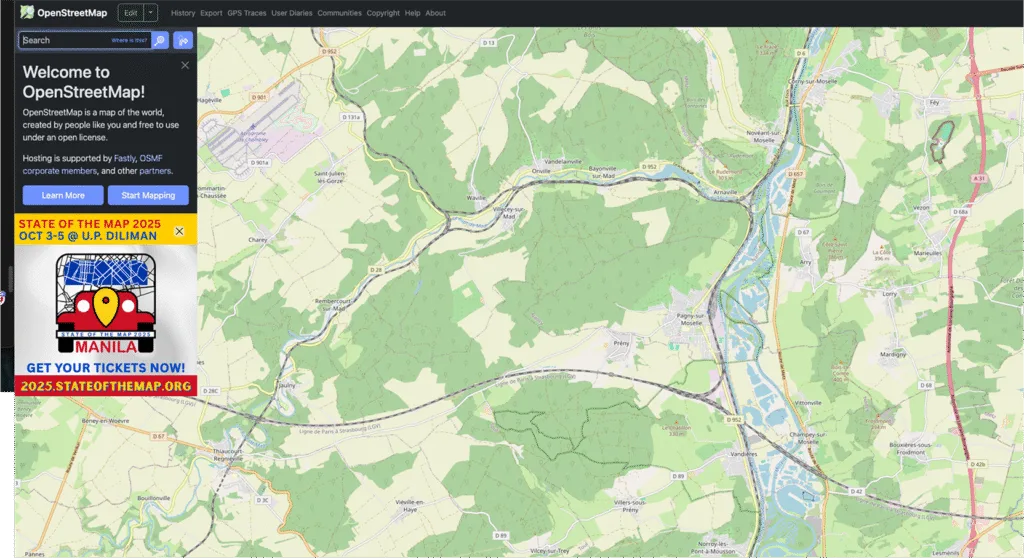
OpenStreetMap provides a free, openly licensed dataset with global geographic detail and broad community contributions. Coverage depth, data structure, and update frequency all vary by contributor and country. Compared to OpenStreetMap, GeoPostcodes offers curated, standardized address structures built from authoritative sources. Compared with Melissa, OpenStreetMap offers more data control and customization through its self-hosted, open-licensed model.
Smarty
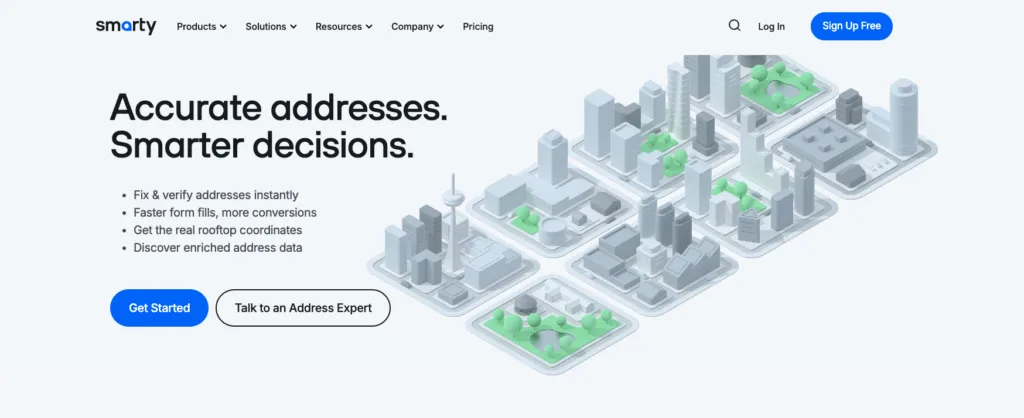
Smarty offers fast, accurate address validation through a developer-friendly API, but does not provide an international downloadable address database. Control over the data is limited to the API response, with no access to the underlying reference dataset. Compared to Smarty, GeoPostcodes delivers an authoritative address database for 247 countries with full data control. Compared with the Google Maps Address Validation API, Smarty emphasizes API speed and developer experience.
Melissa
Melissa delivers address validation and integrates well with CRM, MDM, and e-commerce systems, but it does not offer a downloadable international address database. Performance will depend on the API processing layer and service architecture. Compared to Melissa, GeoPostcodes offers a fully self-hosted international address database covering 247 countries. Compared with Loqate, Melissa emphasizes deeper enterprise integrations, while Loqate emphasizes e-commerce and checkout flows.
Loqate
Loqate offers reliable address validation with extensive integration options across e-commerce platforms, but does not publish an international address database. Compared to Loqate, GeoPostcodes offers a unified, authoritative international address database covering 247 countries and built from 1,500 sources. Compared with PostGrid, Loqate supports a wider range of use cases.
PostGrid
PostGrid offers address validation combined with direct print, mail, and postal services through a unified platform backed by certified postal data. The platform does not provide a downloadable international address database. Compared to PostGrid, GeoPostcodes offers standardized datasets covering 247 countries with full data control and self-hosted deployment. Compared with Smarty, which supports a broader set of validation workflows, PostGrid centers on print and mail.
How to choose the best international address database
Evaluate global coverage
Teams operating across multiple markets require consistent address structures, unified administrative hierarchies, and reliable naming conventions for every country in scope. Single-country datasets or API-based solutions do not provide the coverage needed for analytics, ETL workflows, or global MDM systems. International operations benefit from a dataset that covers all 247 countries with consistent field structures, enabling teams to avoid fragmented pipelines and region-specific exceptions.
Assess authoritative sourcing
Authoritative data from national postal operators and government agencies provides the foundation for correct administrative levels, postal formats, and locality naming conventions. Enterprises depend on this accuracy to support compliance, routing, reporting, and onboarding flows. In contrast, crowdsourced or aggregated data often lacks the depth and precision required at global scale and must be cleaned, merged, and normalized before use, which increases operational effort and risk.
Examine standardization and structure
Address databases must align address formats across 233 postal systems and reflect consistent administrative hierarchies to ensure interoperability across applications. Standardization improves match rates in address validation, prevents erroneous joins in BI workflows, and supports accurate distance calculations or city-based analytics. A structured dataset also reduces the amount of custom logic required in ETL pipelines, lowering maintenance costs and improving long-term reliability across regions.
Clarify update frequency and reliability
Geographical and postal systems change frequently due to new postal codes, renamed cities, administrative restructuring, and evolving subdivisions. Curated datasets ensure these changes flow smoothly into downstream systems. Irregular or community-driven update cycles risk introducing outdated values into analytics dashboards, routing engines, or customer-facing forms. Companies such as DB Schenker and EcoTransIT emphasize the value of accurate updates because their operations rely on correct address data at all times.
Analyze the deployment model
Self-hosted address databases provide predictable performance, offline capabilities, and full data control in data engineering processes. This model avoids latency, bandwidth limitations, and external dependencies typical of API-only services. Teams running large-scale ETL, MDM, or geospatial workflows benefit from local processing because they can customize scripts, implement bulk transformations, and enrich datasets without external constraints. Self-hosting also supports compliance requirements for industries managing sensitive information.
Consider licensing and long-term cost
Usage-based API pricing introduces variability because traffic spikes or high-volume processes raise operational costs unexpectedly. Teams responsible for global analytics, BI, or compliance workflows prefer fixed-cost licensing that allows for stable budgeting and clear resource planning. A self-hosted licensing model also aligns with high-volume use cases such as batch address validation or market analysis, where predictable costs support long-term scalability.
Why enterprises choose GeoPostcodes as their international address database
Enterprises choose GeoPostcodes’ international address database because it provides authoritative, highly structured datasets covering 247 countries with 233 address formats, 299 languages, and standardized administrative hierarchies. Teams rely on the self-hosted delivery model to gain full data control, predictable costs, and high performance for ETL pipelines, analytics, onboarding flows, and logistics systems. GeoPostcodes differs from API-first providers by supplying the complete international dataset that teams use to build address validation, enrichment, and routing workflows at global scale.
FAQ
What is an international address database?
An international address database is a structured dataset of postal addresses across multiple countries, containing standardized address formats, streets and house numbers, postal codes, administrative divisions, and geographic coordinates.
Businesses use these databases to validate addresses, standardize customer records, and support logistics, e-commerce, financial services, and marketplaces across international markets.
In practice, an international address database gives teams one consistent framework instead of one file per country.
What should businesses look for in a global address database?
A global address database provides broad country coverage, multi-language support, global city definitions, standardized address formats, and consistent data structure across every geography.
Update frequency, sourcing transparency, and integration flexibility also matter — the database has to fit inside CRM, ERP, and e-commerce systems without heavy transformation.
Teams evaluating options typically compare providers on these criteria, alongside cost predictability and licensing terms.
How does GeoPostcodes compare as a postal and address data provider for global address databases?
Over the past 15 years, GeoPostcodes has built a self-hosted global address database covering 247 countries, with data curated from 1,500 authoritative sources, including official postal operators and governments.
Coverage spans postal codes in 247 countries, address data in 81 countries, and house-number data in 51 countries.
All are standardized across 233 address formats and 299 languages within a single, unified structure.
Customers such as DB Schenker and Amazon integrate the dataset directly into their own systems, with no per-query fees and no customer data shared with third-party services.
How does GeoPostcodes handle different address formats and languages across countries?
GeoPostcodes supports 233 international address formats and 299 languages within a single unified structure, ensuring that records from every country follow a consistent schema.
Each address record includes standardized administrative divisions, postal codes, alternative names in local languages, and geographic coordinates.
This unified structure allows teams operating across markets such as Belgium, Japan, Brazil, and the U.S. to format and match addresses using a single dataset, without building separate parsing logic for each country.
How is a global address database kept accurate and up-to-date?
GeoPostcodes curates its address database from 1,500 authoritative sources, including official postal operators and government registries, and regularly updates it to reflect changes in postal and administrative data worldwide.
Data specialists deduplicate records, standardize formats, and validate updates across 247 countries to maintain consistent accuracy at every administrative level.
This strong data-quality foundation has enabled customers such as DB Schenker to validate postal data 300 times faster.
Is GeoPostcodes an international address database or an address verification API?
GeoPostcodes provides a self-hosted international address database, not an address verification API or address validation service.
Customers integrate the dataset directly into their CRM, ERP, e-commerce platform, MDM system, or custom application, allowing address validation, formatting, and enrichment to take place entirely inside their infrastructure.
This eliminates per-query fees and prevents customer data from being shared with third-party services.
With a self-hosted solution, teams have complete control over the data, ensuring security, compliance and performance at a fixed cost.
What do GeoPostcodes, Google Maps API, OpenStreetMap, Smarty, Melissa, Loqate, and PostGrid offer for international address data?
GeoPostcodes offers a downloadable, self-hosted international address database covering 247 countries, designed for offline processing, large-scale operations, and reference-data workflows.
Google Maps provides API-based address validation across 40 countries, primarily for consumer-facing forms.
OpenStreetMap offers a free, openly licensed, community-maintained geographic dataset for mapping applications and research.
Smarty provides a developer-friendly address validation API for high-volume workflows.
Melissa combines address validation with CRM and MDM integrations, Loqate supports checkout flows through extensive e-commerce integrations, and PostGrid combines address validation with certified postal data for print and mail workflows.