
Introduction
Most “postal code” search results surface APIs and lookup services rather than actual downloadable, worldwide postal code databases. This comparison focuses on providers that support global postal code reference data, with a clear distinction between self-hosted databases and API-only solutions. Evaluation centers on coverage, data provenance, structure, update practices, licensing, and suitability for logistics, analytics, and data engineering workflows.
Quick highlights:
- GeoPostcodes: Worldwide postal code database for 247 countries, self-hosted, fully geocoded, standardized.
- OpenStreetMap & GeoNames: Free, worldwide coverage, but crowdsourced and inconsistent.
- Google Maps, Precisely, HERE, TomTom: API-first; do not offer a downloadable worldwide postal code database.
Comparison table: Worldwide postal code database providers
| Provider | Postal Code Database Available? | Coverage Description | Data Provenance | Structure & Standardization | Licensing Model | Best For | Key Limitations |
|---|---|---|---|---|---|---|---|
| GeoPostcodes | Yes (downloadable, self-hosted) | Worldwide: 247 countries, 9.3 million postal codes | 1,500+ authoritative sources | Unified global schema, standardized hierarchies | Fixed-cost, self-hosted | Global reference data, address validation, distance calculation, analytics, enterprise systems | No API delivery, requires data engineering to integrate with internal systems |
| Google Maps API | No | ~40 countries | Aggregated, not public | API components, no full standardized postal dataset | Usage-based API | Consumer-facing forms | No downloadable postal database; partial coverage; limited data control |
| OpenStreetMap | Yes | Worldwide but inconsistent | Crowdsourced | Non-standardized across countries, needs cleaning and normalization | Open license with attribution | Mapping, research | Inconsistent quality; heavy cleaning required; attribution obligations |
| GeoNames | Yes | Worldwide but partial postal code coverage with gaps and outdated records | Crowdsourced | Oversimplified postal structure | Free with attribution | Simple geographic reference tasks and basic applications | Non-authoritative; gaps and outdated entries; limited metadata richness |
| Precisely | No downloadable postal code database | Worldwide but relies heavily on third-party data sources | Aggregated, third-party sources | Service-focused, no full standardized postal dataset | License-based software | Large data integrity projects | No downloadable postal database; complex implementation; limited data control |
| HERE Technologies | No downloadable postal code database | Worldwide but coverage quality varies significantly by country | Aggregated | Navigation-centric, no full standardized postal dataset | License-based or usage-based API | Navigation and routing | No downloadable postal database; complex structure; limited data control and possible API latency |
| TomTom | No downloadable postal code database | Worldwide but its coverage across countries | Aggregated | Navigation-centric, no full standardized postal dataset | Usage-based API | Navigation and routing | No downloadable postal database; uneven coverage in some countries; complex data structure |
What is a worldwide postal code database
A worldwide postal code database is a structured, downloadable dataset that contains postal codes, cities, administrative divisions, and coordinates across multiple countries in a unified format. The database serves as a reference layer for logistics, analytics, ETL workflows, and master data systems because it aligns postal information with cities, regions, and geographic hierarchies. Teams use it to validate locations, calculate distances, standardize reporting, and ensure consistent routing logic across global operations.
A true worldwide postal code database contains:
- Postal codes for all countries in scope, not just core markets
- Aligned postal and administrative hierarchies so every postal code is mapped cleanly to cities and regions
- Authoritative sources, such as national postal operators and government agencies
- Standardized schemas, enabling teams to work with a consistent structure across countries
- Accurate geocodes for routing, analytics, and spatial calculations
- Multi-language locality names, including local names, foreign alternatives, and transliterations
- Regular curated updates that reflect postal code changes, new subdivisions, or administrative adjustments
This definition is necessary because many tools marketed as “postal code databases” expose APIs, not databases. APIs return lookup results, but they do not provide the complete, structured dataset required for global ETL, analytics, or master data workflows. A self-hosted postal code database gives teams the control, consistency, and reliability needed to run international operations at scale.
Databases vs APIs: Why the distinction matters
Postal code databases provide complete, structured postal code data for global operations, while APIs only return results without giving teams access to the underlying dataset.
APIs support real-time postal code validation or autocomplete, but they do not replace the need for a downloadable or self-hosted dataset. Teams that require a postal code database need a complete, structured view of postal codes and their associated administrative hierarchies and cities across all countries. This internal reference layer enables consistent ETL workflows, analytics, compliance checks, and global data normalization.
Teams needing worldwide postal code databases require:
- Internal storage for analytics and long-term modeling
- Batch processing at scale without external bottlenecks
- Full control over how fields map across administrative levels
- The ability to audit, enrich, or join postal codes with internal datasets
- The flexibility to run transformations and quality checks locally
- Predictable costs not tied to query volume or peak traffic
- Compatibility with self-hosted environments, BI tools, and data warehouses
- Predictable performance with no dependency on external servers or network latency
- Enhanced security through full data ownership
API-only solutions limit data control because requests pass through external infrastructure. This dependency introduces constraints on customization, rate limits, and latency—factors that affect performance for high-volume pipelines or regulated industries. Teams also cannot inspect, restructure, or enrich the underlying dataset because the provider never exposes it.
Worldwide postal codes databases emphasize authoritative sourcing, global consistency, and integration with enterprise systems, where data control—not API convenience—is the primary requirement. Companies like EcoTransIT and DB Schenker demonstrate the importance of reliable datasets because their workflows depend on accurate, consistently structured global location data rather than API responses.
Why a self-hosted worldwide postal code database matters for global operations
Postal codes define how carriers, tax authorities, and logistics networks interpret locations. Global organizations rely on postal code databases to power routing, ETL workflows, analytics, compliance, and customer experience. A self-hosted postal code database gives teams full data control, predictable performance, and the ability to combine postal information with internal datasets or industry-specific attributes.
API-only solutions return answers but do not expose the full dataset. This limitation makes it difficult to build global master data, run large-scale batch processing, or align multiple country-specific systems into a single reference structure. A downloadable database provides the foundational layer needed for global operations, particularly in logistics and analytics scenarios where every mismatch can translate into failed deliveries or misleading reports.
How we evaluated these worldwide postal code database providers
This comparison focuses on the needs of data engineers, data architects, and GIS specialists responsible for postal reference data at global scale. Evaluation criteria include:
- Global country coverage: Does the provider cover 247 countries or only a subset? Is coverage clearly documented?
- Database availability: Does the provider license a downloadable postal code database, or do they only expose address information through APIs?
- Data provenance: Are the sources authoritative (postal operators, government agencies) or crowdsourced/aggregated?
- Standardization and structure: Does the dataset align postal and administrative hierarchies, and provide consistent schemas across countries?
- Geocodes: Does the provider include reliable coordinates linked to postal codes?
- Update frequency: Are updates curated and regular, or community-driven and ad hoc?
- Licensing and deployment model: Does the provider offer self-hosted database licensing vs usage-based API pricing?
- Metadata richness: Are fields available for local names, multi-language labels, administrative levels, UNLOCODEs, or other logistics attributes?
These criteria matter because teams need a global, coherent reference rather than a patchwork of country-specific lists or opaque API responses.
Best worldwide postal code database providers
GeoPostcodes
GeoPostcodes provides the most comprehensive worldwide postal code database with 9.3 million postal codes across 247 countries. The dataset integrates 1,500+ authoritative sources into a unified global structure that aligns postal codes, cities, administrative divisions, and UNLOCODEs, all fully geocoded. GeoPostcodes differs from Google Maps API by delivering a downloadable, self-hosted postal dataset rather than an API-only service. Compared with OpenStreetMap, GeoPostcodes offers curated, standardized coverage instead of crowdsourced, inconsistent data.

Google Maps API
Google Maps Address Validation API exposes postal information through API responses but does not provide a downloadable worldwide postal code database. Teams must extract components by filtering address results, which increases complexity and depends on only 40-country coverage. GeoPostcodes surpasses Google Maps Address Validation API by offering a standardized, self-hosted postal code database for 247 countries. Compared with HERE Technologies, Google focuses more customer-facing forms, while HERE prioritizes navigation and mapping.
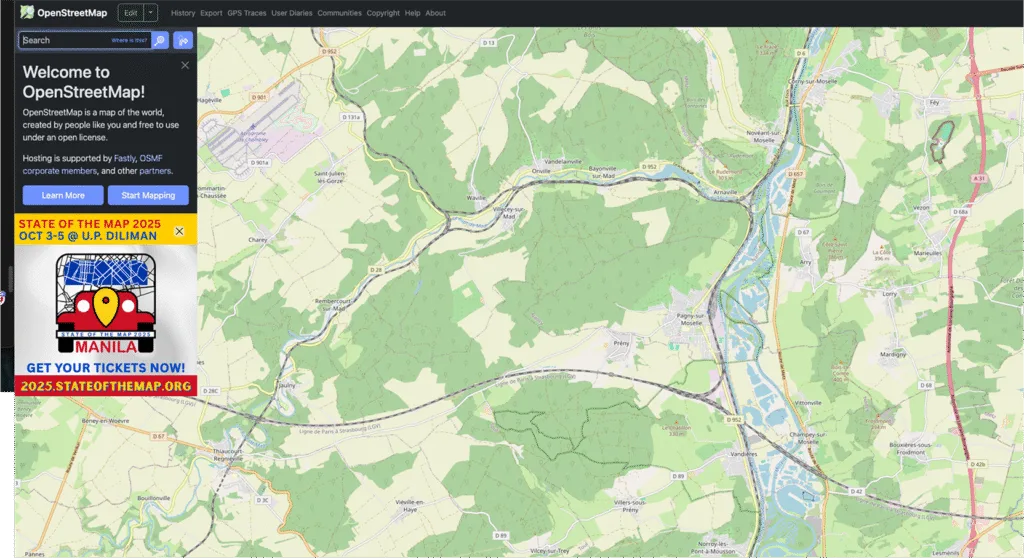
OpenStreetMap
OpenStreetMap offers a free, worldwide dataset that includes postal codes in many regions, maintained by a large volunteer community. Data quality and completeness vary significantly between countries, and the structure remains non-standardized, which requires extensive cleaning and normalization. GeoPostcodes surpasses OSM by providing authoritative, standardized postal code data for 247 countries. Compared with GeoNames, OpenStreetMap offers richer geographical context but shares similar challenges with uneven quality and attribution requirements.
GeoNames
GeoNames provides a low-cost, global geographic database with worldwide coverage and structured postal code data. The dataset relies on crowdsourced contributions and suffers from partial postal code coverage with significant gaps, outdated records in many regions and varying coordinate quality. GeoPostcodes surpasses GeoNames by delivering an authoritative, worldwide postal code database curated from 1,500 official sources with unified administrative hierarchies. Compared with OpenStreetMap, GeoNames offers a lighter format but similar coverage limitations.

Precisely
Precisely delivers a broad suite of data integrity and address services, including verification and geocoding APIs distributed through major cloud marketplaces. It does not provide a dedicated, downloadable worldwide postal code database and relies heavily on external data partners. GeoPostcodes differs from Precisely by acting as the primary postal data provider with a self-hosted worldwide dataset. Compared with the Google Maps Address Validation API, Precisely offers broader international coverage but comes with a more complex and lengthy implementation process.

HERE Technologies
HERE Technologies provides extensive mapping and navigation solutions widely adopted in automotive and mobility applications. HERE does not offer a dedicated, downloadable worldwide postal code database, and its complex data structure is optimized for navigation rather than business applications. GeoPostcodes surpasses HERE Technologies by offering a standardized, worldwide postal code database tailored for logistics and analytics. Compared with TomTom, HERE plays a similar role in navigation but remains equally unsuited for postal data reference needs.

TomTom
TomTom offers high-quality mapping and routing solutions with strong adoption in navigation applications and strategic partnerships in the technology sector. TomTom does not offer a downloadable worldwide postal code database, and coverage varies across countries, particularly in hard-to-source regions. GeoPostcodes surpasses TomTom by providing a complete worldwide postal code database for 247 countries. Compared with HERE, TomTom plays a similar role in navigation but remains equally unsuited for postal data reference needs.
How to evaluate worldwide postal code databases
Check global coverage and consistency
Teams running global logistics, tax, or analytics operations need coverage across all countries in scope, not just core markets. A dataset covering 247 countries with a unified schema helps avoid fragmented pipelines, special-case logic per country, and gaps in routing or reporting. Providers focusing on single regions or API-only delivery cannot serve as the master reference for global ETL and MDM workflows.
Assess whether a true postal database exists
Some providers expose postal codes only through APIs or navigation products. Addressing global needs requires a downloadable, self-hosted postal code database that teams can store, replicate internally, and integrate into their data warehouse or geospatial infrastructure. This distinction is critical because an API cannot substitute for a structured dataset when teams need full coverage, internal joins, and data auditing capabilities.
Examine data provenance and authority
Authoritative sources such as national postal operators and government agencies provide the most reliable and up-to-date postal information. Crowdsourced datasets like OpenStreetMap or GeoNames can be valuable, but they often include gaps, outdated records, or inconsistent administrative hierarchies. For global operations, teams benefit from curated datasets that standardize postal and administrative structures across countries.
Evaluate structure, hierarchies, and metadata
A robust postal code database aligns postal codes with cities, administrative levels, and coordinates. Standardization across countries ensures consistent behavior for address validation, routing, territory mapping, and market analysis. Metadata such as UNLOCODEs, time zones, and multi-language names further enhance downstream use cases, especially for multi-country logistics and analytics.
Consider update frequency and operational impact
Postal systems change regularly due to new postal codes, splits, merges, and administrative reorganizations. Curated update processes reduce the risk of failed deliveries, incorrect taxation, or inaccurate distance calculations. Community-driven or opaque update schedules increase operational risk because teams cannot easily anticipate when corrections propagate into their critical systems.
Analyze licensing, deployment, and cost
Usage-based API pricing creates unpredictability in high-volume scenarios, especially when every lookup generates external requests. Self-hosted postal code databases use fixed-cost licensing, which allows for stable budgeting and supports long-term expansion. A self-hosted delivery also aligns with high-volume use cases such as batch address validation or market analysis, and gives data teams direct control over performance, customization and compliance.
Why enterprises choose GeoPostcodes as their address database
Enterprises choose GeoPostcodes’ worldwide postal code database because it covers 247 countries, sourced from more than 1,500 authoritative providers. The dataset aligns postal codes with cities, administrative hierarchies, and accurate coordinates in a standardized global structure. Multi-language support and unified address formats improve data quality across international workflows. The self-hosted deployment model gives teams full data control, predictable pricing, and high performance for logistics, analytics, and MDM systems, supported by dedicated enterprise consulting.