
Key Takeaways
- International address validation helps businesses reach customers and maintain accurate data
- Each country has unique address formatting rules and standards
- Validation uses APIs or custom validators with regularly updated data
- Validators need matching techniques, reliable data, and continuous updates
Introduction
Not much gets done without a physical address, even on the internet. Whether for an e-commerce platform or a supply chain management system, businesses need physical addresses for their operations. Verifying the accuracy of an address’s components—house number, street name, postal code, city, and state—is critical for businesses to reach their customers and deliver products and services efficiently.
Different countries, and sometimes even states, have their address formats, making international address validation a complex task.
Moreover, street names, postal codes, and city names change more often than you might guess.
As it’s difficult to keep up with all those rules and changes internally, many businesses opt for an address validation service.
How GeoPostcodes can help
Discover how our self-hosted location data powers advanced address verification solutions
This beginner guide takes you through a few use cases for international address validation and shows you how international address validation works.
While we will discuss different aspects of international address validation, this guide’s code example is specifically designed for Singapore. You must modify it according to the particular country you are working with.
Are you curious about unique address systems worldwide? Discover our article on how the Colombian Address Format turns streets into a precise location grid!
🌎 Want to eliminate international address validation errors? Access our enterprise postal zip code database with international address formats. Precise, accurate, and up-to-date. Browse GeoPostcodes database for free.
Why Do You Need International Address Validation?
Businesses need accurate customer addresses, but ensuring that global addresses of your customers are is accurate gets tricky when dealing with international customers.
Address Formatting Challenges
A country’s address format is usually standardized by several federal and state organizations, along with the country’s largest postal services. Different locations require different information in their addresses. In Japan, for example, a person’s postal address is written in order from the largest administration or geographical unit to the smallest, with the name of the customer at the very end. However, Japan Post recommends that you write the address in reverse order if you’re using Roman script or English.
Address Normalization Across Countries
Address normalization across countries is another challenge in address validation. In Belgium, for example, the postal service recommends using abbreviations for multi-flat buildings and only if the line is longer than fifty characters. In France, the postal service recommends writing the last three lines in uppercase. Preferences like these are different in almost every country and postal system.
Common Inaccuracies and Impacts
Deviating formats, incorrect mandatory fields like postal codes, outdated or incomplete addresses, and issues arising from translating one language to another are all inaccuracies that can lead to delays in service, incorrect billing, and other negative impacts on customer experience.
Financial Implications
Additionally, the costs of being unable to reach your customers to inform them of service or billing updates, and shipping something to an incorrect address can add up. Back in 2025, it was already estimated that the cost of a bad address is between $35 and $70 per package, and that’s just for domestic mail. It’s easy to imagine how much higher that cost could be when including international costs like tariffs or overseas shipping.
Benefits of Validated Addresses
Validated addresses also enable geospatial analysis, which can make your business more efficient in various ways. For instance, you can optimize delivery routes and timing as well as accurately calculate how many customers live in a specific area or within a certain distance of a location.
How Do You Validate International Addresses?
First, acknowledge that there are many ways to write the same address. There are some commonalities, yes. For example, most address forms require a country. But as can be seen from the example of Japan, even the same country will sometimes have inconsistencies.
To attempt the problem of validation, you need to understand a country’s address formats, along with their variations and exceptions.
The Components of an International Address Data
An international address has several components managed by different administrative bodies. The tool you use for address validation needs to understand:
- Which components make up the address of a particular country
- Which components are optional, or optional but recommended
- Which components are mandatory
It’s tempting to think that catering for these variances is easy. You would simply add some optional fields and make them mandatory for certain countries, as Amazon.com did for an address in Japan in the example below:
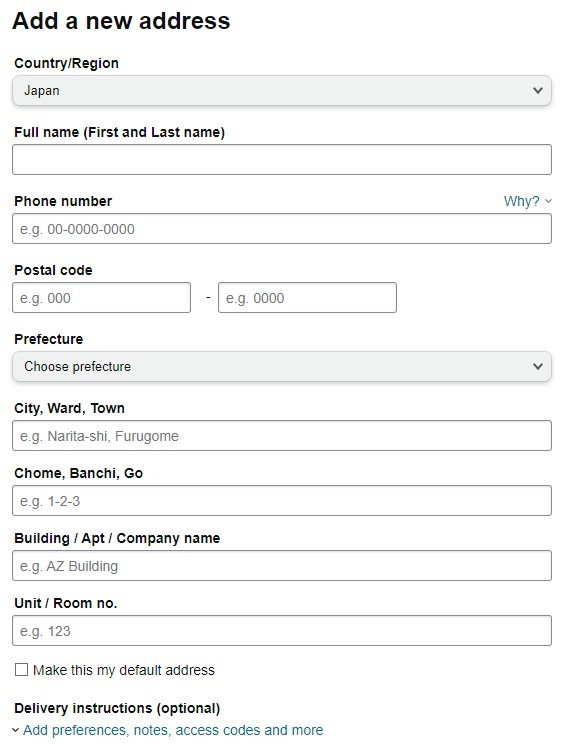
This common solution hides the complexity of different address formats on the front end, but it doesn’t resolve the complexity of having to validate these addresses. It also introduces further challenges. For instance, if users don’t see an address in the format they are used to, they will not know where to enter which values.
So even though Amazon.com uses the format above when you want to deliver something to Japan, Amazon.co.jp uses the following format, which will make sense to someone from Japan:
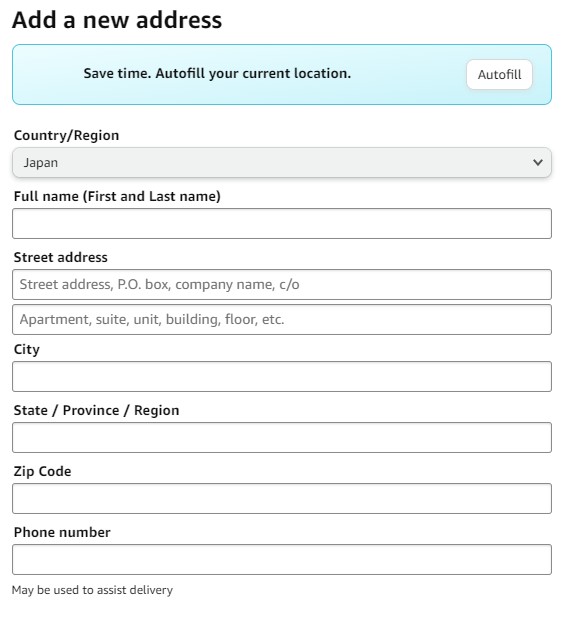
In the Amazon.com example, it’s not clear where to add the mandatory prefecture field, the 000-0000 format isn’t enforced, and should Chome, Banchi, Go be populated in the first or second street address line? Also, the native Japanese format moves from general to specific, like zooming in on a map, until you get to the address. Someone who is used to this format could easily get confused when they have to start at the street level and zoom out to the country level.
Address Lookup by Country
Broadly speaking, there are two main methods for validating international addresses. Both require that you first look up the address format of the country in question. You can then either use vendor-provided APIs to validate an address or your own custom validators.
Let us examine both these methods.
Look Up Formatting through Third-Party APIs
Third-party vendors can validate your international address list, usually by making an API call. Some of these vendors respond with formatted and enriched data, while others use machine learning and artificial intelligence to correct potential errors within an address. Regardless of the methodology, the result you get is a trustworthy validation of an address.
Drawbacks of External API Calls
A downside of this method is that making external API calls for validating addresses can significantly slow down your website, affecting the user’s experience. External API calls can also impose rate limits and come at cost. This cost will sometimes be hard to predict as it’s directly related to the number of calls you’ll make.
Look Up Formatting through Raw Data
The alternative to using a third-party API is to write custom address validators. To do this, you need to take into account different geographies, exceptions to addressing rules, language barriers, and so on. You can run addresses in your raw data across those validators to see whether each address is valid.
Challenges of Static Data
However, only using static, raw data to create the validators is problematic. Names of cities, streets, and counties keep changing. Their boundaries might also be reorganized every so often. If you use a static formatting data lookup method, you must keep the raw data updated to ensure you can validate addresses accurately.
Historical Accuracy
You also need to keep accurate historical records since place names can change. In February 2026, the city of Port Elizabeth in South Africa was renamed as Gqeberha. However, people who have lived there for years are not necessarily going to change their habits overnight. It might take them years to get used to using the new name. And if someone is shipping to them from abroad, they are unlikely to know about this location change. Your validation, therefore needs to have records of the current name and previous ones to validate addresses accurately.
Because of these challenges, it’s best to use vendor-provided raw data. However, remember to refresh the data frequently to incorporate changes like renaming, new suburbs, and so forth.
What Do You Need to Build Your Own International Address Validator?
Creating an address validator is like creating an advanced pattern-matching program.
Deterministic Matching
First off, there are many techniques you can use. For instance, deterministic matching involves the precision matching of different parts of an address with an up-to-date city and street-level database.
Fuzzy Matching with Levenshtein Distance
You could also use Levenshtein distance calculation for partial or fuzzy matching, where you take into consideration small mistakes in the addresses, such as an extra blank space or a minor spelling mistake.
Implementing Custom Validators
Building a custom validator involves coding one or more of these matching techniques into a library. Different applications, services, and users can then use the library to validate addresses based on their own use cases.
Reliable Data Sources
Another non-negotiable component of an international address validator is a trustworthy, accurate data source, such as GeoPostcodes. Its postal database contains all the administrative divisions and postal codes for every country in the world, and its street database is a georeferenced and structured database that can help you validate street-level addresses.
To illustrate how you can use this data for your address validator, let’s look at some sample data for street addresses in Singapore. This data comes from the GeoPostcodes Download Center. The specific file this demo uses is GPC-STRT-GEO-SAMPLE-SG.csv.
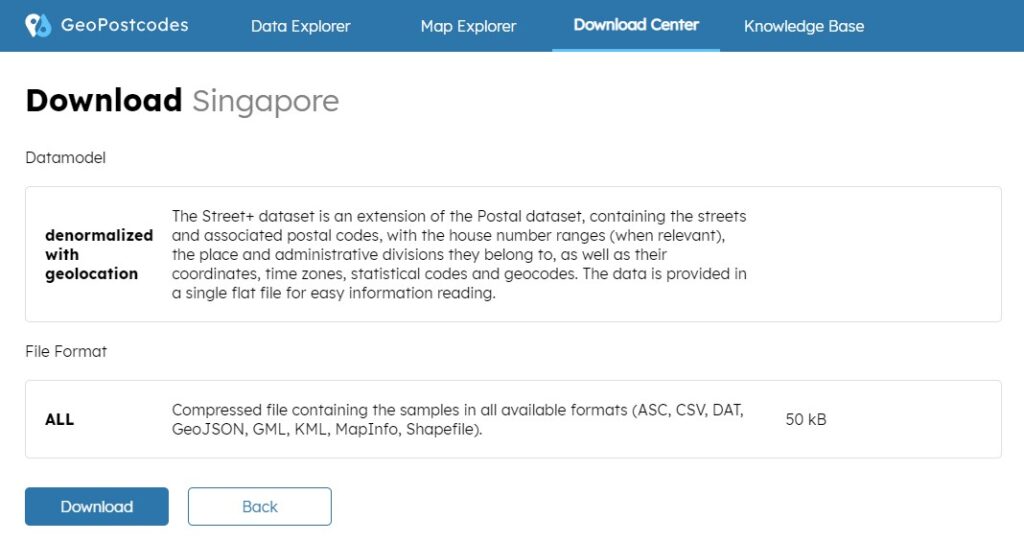
After importing this data into a Postgres database on db<>fiddle, you can run a couple of queries. For example, you can use this data to populate your web frontend with a drop down:
-- Getting all the valid street numbers for a specific street
SELECT "range"
  FROM Singapore
 WHERE "street" = 'Amoy Street'
 ORDER BY "range";
| range |
|---|
| 1 |
| 2 |
| 3 |
| … |
| 109 |
| 110 |
| 112 |
| 115 |
| 130 |
| 131 |
| 132 |
| 133 |
| 134 |
| 135 |
| 137 |
Alternatively, you could use a numeric edit box:
 -- Getting the minimum and maximum street numbers for a numeric edit box
SELECT MIN("range") AS first_number
      ,MAX("range") AS last_number
  FROM Singapore
 WHERE "street" = 'Amoy Street';
| first_number | last_number |
|---|---|
| 1 | 137 |
You can also use this data to help autocomplete an address:
-- Getting street names for an auto-complete
 SELECT DISTINCT "street"
  FROM Singapore
 WHERE "street" LIKE 'A%'
   AND "range" = 11
 ORDER BY "street";
In this example, when someone has entered a street number of 11 and starts typing A, they will get Amoy Street and Ann Siang Road but not Ann Siang Hill as that doesn’t have a number 11:
| street |
|---|
| Amoy Street |
| Ann Siang Road |
You can also use this data to validate a specific address, for example:
 -- Validating a specific street address
SELECT "range"
  FROM Singapore
 WHERE "street" = 'Amoy Street'
   AND "range" = 15
 ORDER BY "range";
This example will give you There are no results to be displayed. because there isn’t a number 15 in the particular street.
These are only some simple, illustrative examples. As you can see, having trustworthy data in the correct format reduces the amount of effort needed to validate international addresses.
Conclusion
Physical addresses aren’t going anywhere, and their impact on business is real, from logistics to marketing to sales. Ensuring the accuracy of the addresses you’re working with is critical to your business success, which is why address validation can’t be an afterthought.
This guide has shown how complex it can be to cater to addresses in different countries, and it highlighted some of the key considerations for ensuring you have accurate data. We also showcased how reliable data helps address some of the challenges with validation.
Instead of maintaining all that data, let GeoPostcodes handle it for you. Consider its highly maintained data sets so you can best serve your international customers.
FAQ
What does it mean to standardize an address?
To standardize an address means to convert it into a consistent format that adheres to specific postal guidelines.
This process involves correcting abbreviations, ensuring proper spelling, and reformatting address components — street number, street name, city, state, and ZIP code — according to the standards set by the postal authority.
Standardizing addresses ensures accuracy, improves deliverability, and minimizes errors in mailing and shipping operations.
What is the standard format of an address?
The standard format varies by country but generally includes: recipient name, street address, city, state or province, postal code, and country. For example, the USPS standard format for a U.S. address is:
John Doe
123 Main St
Springfield, IL 62701-1234
USA
This format ensures all elements are present and correctly positioned, facilitating efficient mail processing and delivery.
Why can’t an address be standardized?
An address might not be standardized due to several reasons:
- Incomplete information: Missing elements such as street number, street name, or ZIP code.
- Invalid information: Addresses that don’t exist or contain fictitious elements.
- Incorrect formatting: Addresses that don’t follow postal authority guidelines.
- Database limitations: The address may not be listed in the postal authority’s database, especially for new construction or remote areas.
If the input address data is flawed or the database lacks the necessary information, the address cannot be standardized effectively.
What is the USPS address standardization system, and how do I use it?
The USPS address standardization system converts addresses to the USPS’s preferred format using the Coding Accuracy Support System (CASS).
CASS-certified software ensures addresses are properly formatted, validated against the USPS database, and corrected if necessary. This improves mail delivery efficiency, reduces undeliverable items, and qualifies mailers for postal discounts.
Use GeoPostcodes’ USPS address verification service to standardize and validate addresses in accordance with USPS requirements.
What database helps with address standardization, and can it handle international addresses?
GeoPostcodes’ postal address validation database includes standardization rules for global addresses across 247 countries.
It covers international addressing standards and formats, handling each country’s postal requirements.
For international addresses, the database supports 233 address formats and multi-language data across 299 languages, making it suitable for both domestic and global address standardization needs.
How do address verification services work?
Address verification services check postal addresses against authoritative database records in real time or in batch mode.
The process scans for incorrect formatting, mismatched city and postal code data, and spelling errors — then corrects or flags them before they enter the system.
Most services integrate with CRM and ERP systems via APIs, enabling automatic verification at the point of data entry. For payment transactions, the process typically completes within a few seconds, from the moment a customer submits billing information to when the business receives an authorization or decline response.
Address verification services also speed up checkout by making it easier for users to input addresses and complete purchases. Validated address data improves CRM quality, so communications reach the right people with more relevant content — reducing failed deliveries and improving customer loyalty.
What is an address verification service (AVS), and how does it handle mismatches?
An address verification service (AVS) is provided by major credit card processors to authenticate ownership of a credit or debit card.
AVS runs during card-not-present transactions, cross-referencing the billing address provided by the cardholder against the card issuer’s records to combat fraud and reduce chargebacks. It’s most common in the United States, Canada, and the United Kingdom.
AVS response codes indicate the degree of address matching and help merchants decide whether to accept or reject a transaction. When a mismatch occurs, the card issuer typically declines the transaction.
AVS isn’t available for all credit card providers and generally doesn’t support foreign credit cards — cardholders may see an error at online stores if their bank doesn’t support AVS.
How does real-time address verification work?
Real-time address verification checks an address as a user inputs it — rather than cleaning bad address data after the fact.
It uses GPS and Wi-Fi signals to verify physical presence at the provided address. This makes it especially useful for card-not-present transactions, delivery confirmation, and fraud prevention.
By catching bad addresses at the point of entry, real-time address verification reduces costly errors before they reach the rest of the business.
What are the top address verification software solutions?
Several address verification software solutions are widely used across e-commerce, logistics, CRM, and enterprise data workflows. Here’s a breakdown of the main options.
GeoPostcodes provides authoritative, self-hosted datasets with worldwide coverage across 247 countries, standardized address formats, multi-language support, and full data control. Datasets are built from 1,500 official sources and deliver consistent, unified address structures for international verification.
Google Maps Address Validation API offers strong developer adoption and a smooth consumer-facing experience, with address validation coverage across 40 countries. It benefits from strong brand recognition, particularly among consumer-facing applications.
OpenStreetMap is a free, international address database with granular detail contributed by an active global community. Data structure, coverage depth, and update cadence vary by contributor and country.
Smarty delivers fast address verification through developer-friendly APIs, with broad adoption across e-commerce, logistics, and CRM integrations. It emphasizes speed and simplicity for API-driven workflows.
Melissa provides address verification and data quality services that integrate with CRM, MDM, and e-commerce platforms, available through API-based products for real-time and bulk processing. It focuses on deeper enterprise integrations.
Loqate offers address verification solutions with extensive integrations across major e-commerce and checkout platforms, supporting a wider range of use cases.
PostGrid combines address verification with direct print, mail, and postal services through a unified platform. Verification is backed by certifications from postal authorities such as USPS CASS and Canada Post SERP.
What is AVS disambiguation?
AVS disambiguation is the process of resolving multiple possible matches for a single address input.
When a system runs address validation, it often encounters ambiguity — for example, an input address like “10 Main Street, Springfield” can match several valid locations across different regions.
AVS disambiguation combines multiple data signals to identify the most accurate match, including postal codes, administrative divisions, street-level data, and geographic coordinates.
Without it, bad addresses slip through validation, leading to wrong location assignments, failed shipments, and duplicate records — all of which create costly errors at scale.
A high-quality reference dataset, like GeoPostcodes’, improves disambiguation accuracy by providing structured, standardized, and globally consistent address data.