

International
ZIP Code Database

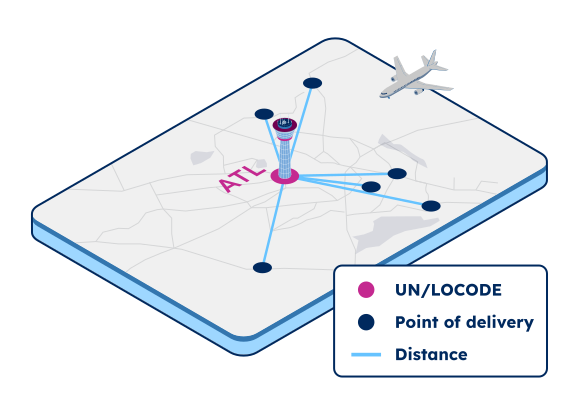
Enterprise-grade location data covering 247 countries, curated from 1,500 sources.

Explore our international ZIP code database coverage

One source of truth

A single database curated from 1,500 authoritative sources, including postal operators and official governments.

Standardized structure

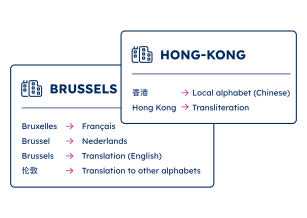
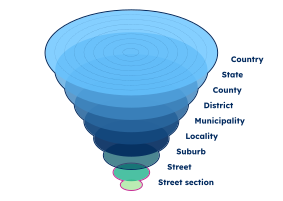
Unified global ZIP code structure with standardized fields, multi-language support, and consistent administrative levels.

Always up-to-date

Regular updates from our data specialists to reflect the world’s changing geography.

Key features of our international ZIP code database

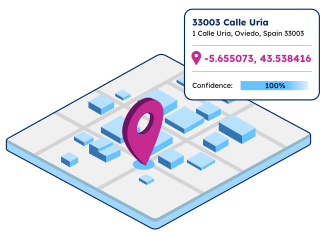
Fully and accurately geocoded

Geographic coordinates (latitude and longitude) are provided for all ZIP codes, cities, and towns in the WGS 84 coordinate system.

Achieve global geocoding accuracy

"GeoPostcodes has helped us enrich our internal data with accurate coordinates for postal code matching on a global basis. We calculate distances between the customer’s home address and different event venues to calculate event relevance and optimize marketing activities and spending."

Dr. Timo

Dr. Timo

Head of Customer Analytics & Campaign Management, Eventim
Fully and accurately geocoded

Trusted by industry leaders

Join more than 100 enterprise clients who trust GeoPostcodes for their location data

GeoPostcodes - Ecotransit logo
“GeoPostcodes’ global ZIP codes allow us to determine distances accurately. Thanks to their up-to-date database, we no longer have problems with missing locations, making our system much more efficient and reliable.”

Anjo Grebe

Consultant

“GeoPostcodes databases provide IATA codes, enhanced UNLOCODEs with port terminal data, addresses, and more – all on a global scale! This level of accuracy is essential for our mileage and CO2 emissions calculation.”
GeoPostcodes - Peter Wild CarbonCare

Dr. Peter Wild

Managing Partner

“GeoPostcodes’ Population data shows population forecasts over the next years. We can use it as a proxy to justify longer-term changes and downgrade postal code areas in terms of economic viability.”

Kousha Mazloumi

Director of Data Science

“The concept of the city receives different names or belongs to different hierarchical levels depending on the country. Using GeoPostcodes’ data gave us access to city definitions aligned with our customers’ expectations, saving us computation time.”

Kousha Mazloumi

Director of Data Science

GeoPostcodes - Logo_DB_Schenker
“The world is constantly changing. New localities and neighborhoods open up or become dispersed. It’s good to know that GeoPostcodes is keeping on top of those changes and providing us with updated information to work with.”
GeoPostcodes-GeoPostcodes-William chao picture

William Chao

Product Owner of Geographic Information Services

GeoPostcodes - Bark Logo
“The key aspect of working with GeoPostcodes has been their ability to provide customized data solutions. Their collaborative approach has made them an excellent partner in addressing our location data challenges.”

Kate Kilby

Senior Product Manager

GeoPostcodes - Opterrix-logo
“GeoPostcodes’ multi-level boundaries were perfectly aligned, enabling seamless integration with multiple secure cloud platforms. Our software can now provide more accurate visualizations for risk analysis and natural hazard monitoring.”

Dave Hamm

Project Manager

“Countries like Brazil or China are particularly strict with their customs validation. GeoPostcodes’ ZIP codes and Enhanced UNLOCODES database are aligned with national regulations, ensuring seamless transportation and compliance.”
GeoPostcodes - Kavian Ranjbar

Kavian Ranjbar

Data Governance Specialist

“If you’ve got a business where locations are a big part of it and you’re looking to avoid the large costs that can be involved in using APIs, GeoPostcodes’ on-premise database is definitely worth considering.”
GeoPostcodes-Nick Baugie

Nick Beaugié

Senior Software Engineer

Why choose GeoPostcodes

Global coverage

Complete coverage across 247 countries, including hard-to-source geographies like China, Japan, Brazil, and Russia.

Highest quality

Built on extensive, authoritative sourcing with robust data engineering and quality control. Standardized and up-to-date.

Expert Consulting

With 15 years of experience, we guide your implementation and deliver data in the format that fits your system.

How to integrate our self-hosted ZIP code database

Flexible deployment, seamless integration and structured updates, all within your own infrastructure.

1

Choose your delivery method

Select the delivery option that fits your infrastructure.

Manual download

Download the full database directly from your Customer Portal.

Download API

Retrieve the full files via API for automated ingestion into your pipeline.

Cloud-to-cloud

Access the data in your cloud environment: Snowflake, Azure Data Share or AWS.

2

Integrate into your system

Import the data easily into any software, database, ERP, CRM, MDM, GIS, BI and GIS system.

3

Stay up to date

Frequent updates will keep your ZIP code data always up-to-date.

Bulk updates

Download full, updated datasets to refresh your system.

Differential updates

Retrieve only the new, updated and deleted records to ensure integrity and traceability.

Data dictionary

Comprehensive field definitions and data specifications from GeoPostcodes ZIP code database

Field nameDescriptionField type
ISOISO 3166-1 country codeChar(2)
CountryCountry nameChar(50)
LanguageLanguage codeChar(2)
IDRecord identifierInteger
Region 1Administrative division level 1Char(80)
Region 2Administrative division level 2Char(80)
Region 3Administrative division level 3Char(80)
Region 4Administrative division level 4Char(80)
LocalityLocality nameChar(80)
PostcodeZIP / Postal codeChar(15)
SuburbLocality subdivisionChar(80)
LatitudePlace latitude (WGS84 coordinates)Double
LongitudePlace longitude (WGS84 coordinates)Double
ElevationElevation in metersInteger
ISO2ISO 3166-2 region codeChar(10)
FIPSNGA geopolitical code (formerly FIPS PUB 10-4)Char(10)
NUTSEuropean statistical division codeChar(12)
HASCHierarchical administrative subdivision codeChar(12)
STATNational statistics/census codeChar(20)
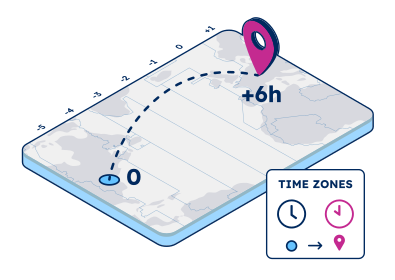
TimezoneTime zone name (Olson)Char(30)
UTCStandard time expressed as an offset with respect to UTCChar(10)
DSTDaylight saving time expressed as an offset with respect to UTCChar(10)
locality_typeType of place, ‘town’ or ‘business’Char(20)
is_postalWhether the postal code is used for regular mailInteger
is_businessWhether the postal code is used for businessesInteger
is_po_boxWhether the postal code is used for PO BoxesInteger
post_townPostal Town (e.g. USPS recommended city)Char(80)
BLOG

Check our related articles

Frequently Asked Questions

The GeoPostcodes’ Postal database covers the whole world with a standard structure. It includes data from all other countries than USA, which USPS covers. USPS does not deliver an exhaustive database of addresses nor postal codes in the USA, but only tools to verify postal codes or addresses.

Other vendors collect USPS information and resell it. The GeoPostcodes Postal database differs from that USA data by all the features and services detailed above, for instance, the multi-lingual support, the geocodes and the timezone information.

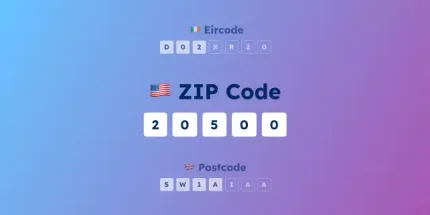
A ZIP Code is a numerical system consisting of 5 digits utilized by the United States Postal Service (USPS) to facilitate the sorting and delivery of letters to their intended destinations. The term “ZIP” stands for “Zone Improvement Plan.”

In other countries, the terms “postal code”, “postcode” or “pin code” are also used. ZIP code data plays a crucial role in various business operations within the United States, serving as a vital parameter for mailing, fraud detection, and demographic research tasks.

The size of a ZIP code database can vary depending on the level of detail and the amount of information it contains. A 5-digit ZIP codes database and their corresponding city or location names would typically be relatively small in size, usually measured in kilobytes (KB) or megabytes (MB).

However, more comprehensive ZIP code databases can include additional data such as coordinates, county names, state codes, and other geographical attributes. These databases can grow significantly in size, ranging from several megabytes to gigabytes, depending on the extent of information they provide.

A billing ZIP code is a numerical code to identify the location of the address associated with a credit or debit card. When making a purchase or transaction online or in person, merchants often require customers to provide their billing ZIP code as a security measure to verify the authenticity of the card.

By matching the provided billing ZIP code with the one associated with the card on file, merchants can reduce the risk of fraudulent transactions.

As of today, there are more than 40,000 ZIP codes in the United States. Please note that ZIP codes can be added, modified, or removed over time due to population changes, urban development, and other factors.

While “postal code” and “ZIP code” generally refer to the same concept in the United States, be aware that the terminology and format may differ in other countries. The term “postcode” is common in the United Kingdom, Australia, the Netherlands, and Germany, while “postal code” is generally used in the rest of the world, such as in Asia. In India, the most common term used is “pin code”.

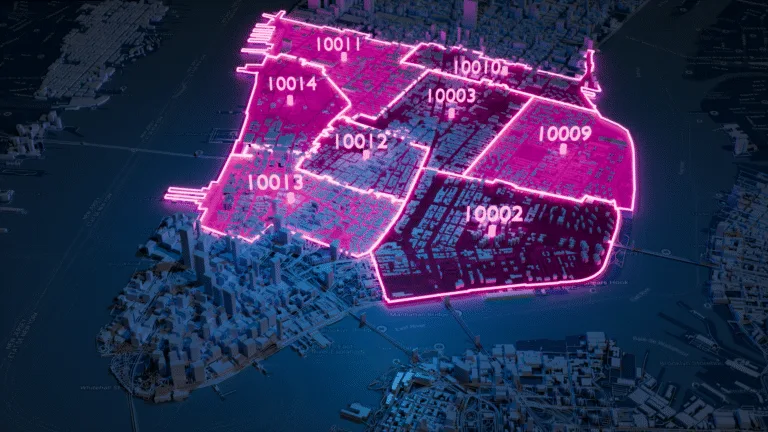
The five-digit ZIP code represents delivery points throughout the United States (incl. PO boxes) and is composed of three main parts: the National Area, Region or City, and Delivery Area. Additionally, USPS has divided the entire country into 10 ZIP Code areas, numbered 0-9, starting from the northeast. The first digit of the ZIP code indicates the state to which the mailer should be sent.

A ZIP Code is a postal code used by the USPS to identify specific mail delivery areas.

It denotes precise geographic locations for mail sorting and delivery. ZIP Code Tabulation Areas (ZCTA) are statistical entities created by the Census Bureau (American Community Survey) based on aggregating census blocks sharing the same predominant ZIP Code. It’s used for census data reporting and demographic analysis.

In essence, a ZIP Code refers to a postal area for mail delivery, while a ZCTA is a statistical approximation of that area used for census and data analysis purposes.

For the past 15 years, we’ve mapped the world ZIP codes, saving you the effort. Over the years, we’ve gathered valuable knowledge, enabling us to create the most complete and accurate ZIP codes database files in the world. We use 1,500 different data sources and update our database 3 times a week.

Our databases are available through an annual license. This license covers the full right to use our data. It also includes full access to product updates and support. Our Enterprise and Product Licenses also come with several days of integration help included.

The cost of our database depends on the geographical coverage your use case requires. Additional datasets can also be included.

To receive additional information and an offer tailored to your needs, please contact us via our request quote page.